
proudly made without AI, always
by Bastien Vassort
Hello! Welcome to this first blog post on the Biophilia project. My name is Bastien, I’m a student at Wageningen University (WUR), studying Resilient Farming and Food Systems. At the moment though, I’m doing an internship with Flora Roberts as part of Future Food Utrecht, where one of the things I get to do is be an active member of Biophilia. Other things that I’m focusing on during the internship include exploring Living Labs, researching European initiatives similar to Biophilia, and interviewing stakeholders in the (alternative) food system in the Utrecht area. This will lead to developing recommendations for a Living Lab on Sustainable that Utrecht University (UU) is currently designing with other stakeholders.
An important point: I don’t presume to speak for Biophilia – these are just my personal reflections and musings about things that come up during my internship.
For this first post, I thought it might be relevant to explore the concept of Biophilia and its history – since it’s what underlies the whole project – before moving on to what the Biophilia project initiated by UU actually is, and what we do.
Quick background: the concept of Biophilia, often erroneously referred to as the Biophilia hypothesis, first emerged in 1973 in American psychoanalyst Erich Fromm’s work. Here, it was defined as “the passionate love of life and of all that is alive”. It was later popularized in American biologist Edward Wilson’s book “Biophilia” (1984), where he defined biophilia as “the innate emotional relationship between humans and other life forms”. In his book Wilson argued that this innate relationship was common to all humans due to its genetic origin, something that has yet to be proven by scientific investigation. To back up his theory, Wilson considered the qualitative evidence that supports his hypothesis – the seemingly universal appreciation of natural beauty, as well as the presence of symbolic use of nature in human languages or spiritualities. It’s generally agreed that the “strongest” evidence for biophilia emerges from studies of biophobia – the “fear of nature”, where measurable physiological responses emerge in human exposed to, say, snakes or spiders. Since these are emotional reactions, proponents say it supports biophilia.
At the end of the day, I’m not here to prove or disprove whether biophilia as a genetic phenomenon is a thing or not. I’m not very interested in that. I observe appreciation and an “emotional connection” to living things in people around me, and that’s enough for me. Instead, I want to consider the original context in which the concept of biophilia was first developed. What was it arguing for, or against?
In his book, Wilson observed that both the development of technology, and the increasing amounts of time humans spend in anthropocentric environments lead to an “attenuation in the human drive to connect to nature”. This, in turn, would lead to a loss of meaning humans attribute to nature, and a loss of respect for its processes.
He brings this into the frame of conservation: in a world currently undergoing its 6th mass extinction event, reconnecting humans to the natural world is crucial to support conservation efforts. Wilson suggests that humans should return to environmental stewardship, grounded in the practical dependence of humans on nature; the satisfaction derived from interaction with nature (exploration, outdoor skills, gardening…); the physical appeal of nature; and the human attachment to nature in the form of emotional connections to landscapes and animals (notice here that humans are still defined as separate from nature…).
Today, the main use of biophilia as a concept is in biophilic design, in both architecture and urban planning. It entails making space for natural processes within design projects. In this way, biophilic design is claimed to contribute to sustainability, overcoming the lack of contact with nature and effectively managing natural resources.
There have been many architectural and urban projects that incorporate parts of the philosophy of biophilic design, not always intentionally. This wonderful article has a table full of examples of buildings incorporating different “Biophilic Design Elements”, along with explanations of pros and cons of certain strategies. I’d love to get into some specific buildings, but for the sake of brevity, I’d recommend checking out the Bosco Verticale, 2 skyscrapers covered with 800 trees and thousands (!!) of other plants. The Sun Rain room is also fascinating (although perhaps impractical?), and maybe more shocking is the (famous?) Frey House II, that follows the patterns of the landscape down to the angle of the roof.
That’s with regards to biophilic design in architecture. In urban design, bringing up examples is more complicated, as cities have existing infrastructure that may need to be overhauled in order to incorporate biophilic elements. For examples, check out the website of Biophilic cities, a network of cities attempting to incorporate biophilia in their planning.
In this article by researchers at TU Delft, Amsterdam and the WUR, the authors explain biophilic urbanism (BU) in the following way:
“BU differs from other urban approaches—such as green, blue, or brown architecture—by prioritizing prolonged and high-quality human exposure to nature, with the aim of maximizing the resulting positive effects on citizens’ well-being.”
The authors also bring in the concept of the city as a living organism, which I think is such an inspirational idea, and a vivid portrayal of a belief that’s been developing for me throughout my studies: if we view the “outside world”, i.e. the planet’s ecosystem as a whole, a collection of living beings inseparable from each other (so as a whole, living body), what does it say about our societies that we view ourselves apart from that? If we don’t view the places we inhabit as living organisms, if we view the world we live in every day as dead, inert, but only external “nature” as alive and vibrant, how does that reflect the perception of ourselves as a species? Should we not strive to integrate ourselves into that “other”?
Anyways, this discussion about biophilic urbanism brings me to the Biophilia project. Here’s the story as I know it: the project started when Dr. Flora Roberts was awarded USO-funding aimed at finding ways to support students in building the resilience, necessary to address and process difficult topics – in this case, the climate crisis. The location of the project was chosen as the courtyard of the University Library City Centre, Drift. This is one of the hottest places on the heat map of Utrecht (unsurprisingly, if you’ve been there – the place is basically a block of concrete and brick). Flora wanted to invite students enrolled in the Environmental Humanities minor to join a project exploring biophilia on and beyond campus.
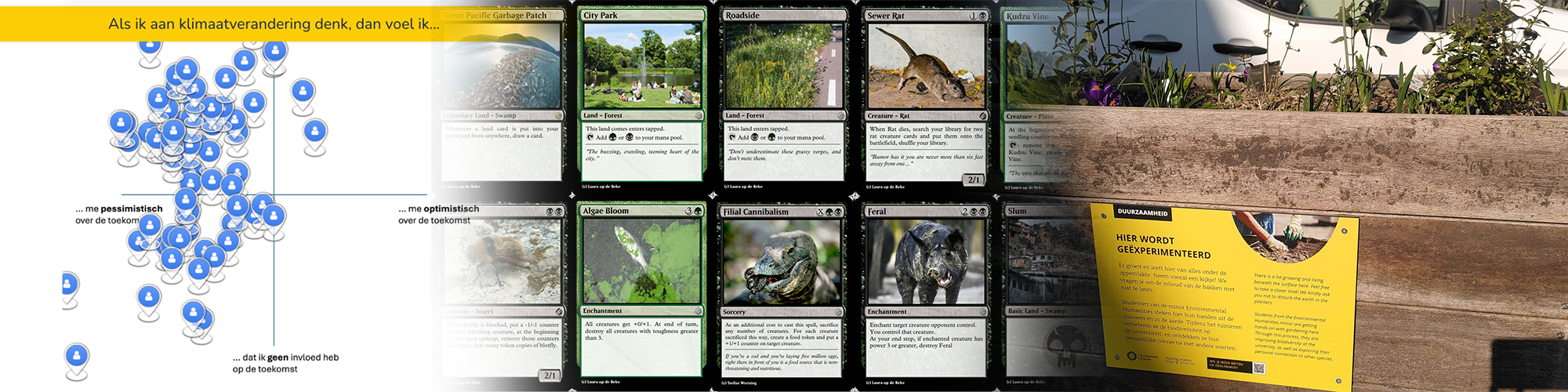
The project has now been active for a year, punctuated by weekly lunch meetings on Mondays, where all members come together, learn together, garden together and decide on what projects to undertake together, with food (if possible harvested from the edible garden) taking centre stage. The activities organized by Biophilia include a festival on June 12, movie nights, fermentation and embroidery workshops, all organized either by members or their friends. These activities and dynamics make for a living, breathing project that goes beyond a simple extracurricular university activity.
Recently, Biophilia members came together to publish a manifesto highlighting our values. This zine, written by the Biophilia collective as a group, highlights our commitment to creating an open, friendly and welcoming space, for humans and more-than-humans. It centralizes food as our way of interacting and gathering – here, we choose local, healthy, and organic food whenever possible. Beyond all of that, what comes out clearly to me as I read the manifesto (which is in the shape of a zine you can get here!) is everyone’s commitment to
- operate as an autonomous community that is rooted in local groups and initiatives that happen in Utrecht. Essentially, there is a clear focus on being active members of the Utrecht activism network, and trying to bring initiatives as well as people together.
- decolonial action. Here, this entails active and explicit solidarity with the people of Palestine, as well as positioning against “monoculture, against fossil fuel fertilizers, against agro-giants” and supporting “small-scale, local initiatives that seek an equitable, responsible and sustainable relationship with the land”.
To bring this article to a conclusion, I want to say that I’m super inspired by all the fascinating things this internship means – looking for cool initiatives across Europe, interacting with people who make me feel hopeful, reading studies that challenge the way I think …. Basically, I’m looking forward to writing more blog posts! The next one will be on an art/research residency based near a natural park in Finland, and their ideas of constructing post-capitalist futures (and how that might relate to biophilia).